
At Mutapa Investment Fund, we are committed to creating wealth and long-term value for the people of Zimbabwe through the prudent management of our portfolio of companies and investments. Our organization is guided by a strong commitment to governance, transparency, and accountability. We achieve this by consolidating the Government’s portfolio of commercial companies and investments, and deploying our investment strategy to generate wealth and stability.
MIF Objectives
To preserve and grow wealth on a sustainable basis from the Fund’s portfolio companies and investments for Zimbabwe’s current and future generations.
The Fund operates in the following multiple sectors of the economy that include thirty (30) investee companies and more than thirty (30) subsidiaries of these portfolio companies, namely:
Our Purpose
The Fund’s purpose is to lay a strong economic foundation to anchor the long-term sustainable growth of the economy in line with the aspirations of Vision 2030 of transforming Zimbabwe into an Upper Middle Income Country that provides a high quality of life to all its citizens by 2030.
The Fund is therefore committed to optimising benefits and building investment assets for current and future generations.
To drive sustainable economic growth, Mutapa Investment Fund will professionally manage its funds and assets, leveraging international best practices and corporate governance principles to maximize value for the benefit of current and future generations.
Additionally, the fund will serve as a strategic investment arm of the Zimbabwean Government, providing a platform to attract foreign investment through co-investment opportunities, asset consolidation, and unlocking value from underutilized assets, thereby generating optimal returns.
Objectives
- To contribute to Zimbabwe’s sustainable economic development by professionally managing funds and assets, optimizing their use in accordance with international best practices and corporate governance principles.
- To maximize value for the benefit of current and future generations.
- To serve as a strategic investment arm of the government, providing a platform for strategic investments and foreign partnerships.
- To attract foreign investment through co-investment platforms, asset consolidation, and unlocking value from underutilized assets, thereby achieving the highest possible returns on investment..
MIF CEO’s Statement
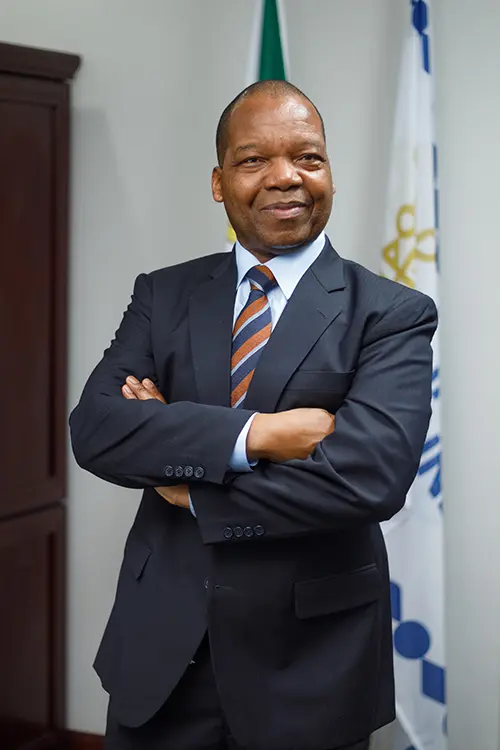
Mutapa Investment Fund is a young and dynamic holding company with a mission to create long-term value for Zimbabwe. The Fund was established by an Act of Parliament Chapter [22.20], as amended to provide strategic oversight over a diverse portfolio of thirty (30) investee companies and investments, including more than 30 subsidiaries of these entities.
The Fund is the strategic investment arm of the government of Zimbabwe. We uphold a philosophy of long-term value creation, and we are committed to transforming Zimbabwe’s resources into assets that generate wealth for current and future generations.
As the CEO of the Mutapa Investment Fund, I am proud to lead an institution that is dedicated to creating long-term value for the people of Zimbabwe and future generations.
In our pursuit of this mission, we have assembled a team of experienced professionals who are dedicated to identifying and investing in opportunities that will drive economic growth and development in Zimbabwe.
As we look to the future, we are excited about the potential for Zimbabwe to grow into a major economic power in Africa. We are committed to playing a leading role in this development.
Our interests are aligned with those of the people of Zimbabwe, and we are dedicated to creating a better future for our country. We believe that our investments will not only generate returns but also contribute to the development of key sectors such as mining, transport, energy, manufacturing, and infrastructure.
I would like to take this opportunity to express our gratitude to the Government of Zimbabwe for its continued trust and support. We are committed to working with all stakeholders to achieve our shared goals and create a brighter future for all Zimbabweans
Governance
Our Governance framework ensures that we uphold the highest standards of corporate governance and transparency. The Fund’s values are strongly built on the principles of transparency, accountability, and sound corporate governance. Our Board of Directors are responsible for overseeing the organization’s corporate governance affairs and related policies and procedures. Our Board of Directors and various committees ensure that our operations are managed in a responsible and prudent manner.
Working with our Portfolio Companies
We work closely with our portfolio companies to ensure their success and growth. We participate in the establishment of high-calibre boards and management teams, provide strategic guidance and supervision, and actively engage with them to promote sound business practices.
Board Committees
We have established Board committees to oversee our operations and ensure that our investment activities are aligned with our mandate:
Investment Committee:
This committee reviews and recommends our investment strategy, oversees the performance of our investments, and approves investment and divestment transactions.
We strive to generate bankable business ideas and conducive enterprise structures to attract investment, both private and public.
We believe that this will lead to the growth of our economy and the creation of new opportunities for Zimbabweans.
The title of the committee shall be: “INVESTMENTS COMMITTEE”
MANDATE AND BUSINESS OF THE COMMITTEE
1.1. In line with the Sovereign Wealth Fund Act of Zimbabwe [Chapter 22:20] as amended, the Committee is
empowered to carry out the mandate as set out herein. The Investments Committee (“the Committee”) is a
committee of the Board whose role is to assist the Board of Directors in discharging its responsibilities in respect of
proposals for the acquisition/disposals of assets, businesses and/or companies by the Mutapa Investment Fund and
mergers between any of its assets with other companies or potential investment assets (“investment
opportunities”). This includes such activities for the companies that are wholly are and partially owned by the
Fund,- namely, the State- Owned-Enterprises. (SoE’s). The Committee is accountable to the Board to properly
consider and evaluate any matters it has been assigned by the Board, which has ultimate responsibility for the
actions of the Committee.
1.2. The Committee shall provide assistance to the Mutapa Investment Fund ( MIF) Board of Directors in fulfilling their
oversight responsibility relating to the Fund’s contemplated investments and portfolio companies and investments.
The Investment Committee is responsible to the Board of Directors of MIF.
1.3. The committee assesses and evaluates opportunities, and provides its recommendations to the Board, for the
Board’s separate evaluation and approval. It is also subject to the limitations contained in the approval framework
1.4. In performing its assessment and evaluation, the Committee ensures that, amongst other things, such investment
opportunities align with the Board’s overall strategy, appropriately account for the Board requirements and create
meaningful value for the shareholders and other stakeholders.
LIMITATION OF MANDATE SCOPE
2.1. It is the responsibility of the Management to identify and assess investment opportunities and to present such
opportunities to the Committee.
2.2. It is the responsibility of the Committee to:(i) evaluate and assess such opportunities;(ii) provide recommendations
or guidance thereon to the Management; and (iii) if deemed appropriate, approve such recommendations to be
made to the Board in relation to such investment opportunities.
2.3. The Committee does not assume the roles, functions and responsibility of the Board and Management.
2.4. The Committee may engage the advice of independent professional advisors in its assessment and evaluation of
investment opportunities and may invite to its meetings, the attendance of outsiders with relevant experience and
expertise it considers necessary.
COMMITTEE COMPOSITION AND CONSTITUTION OF MEETINGS
3.1. The Committee shall comprise not less than seven (7) members including the Chief Executive Officer and the Chief Investment Officer.
3.2. The Deputy Chief Investment Officer shall not be a member of the Committee, but shall attend meetings of the Committee as an invitee.
3.3. A simple majority of members shall constitute a quorum. Invited participants are not part of the quorum and do not vote.
3.4. The failure by the Committee to have the minimum number of members does not limit or negate the authority of
the Committee or invalidate anything done by the Committee while their number is below the minimum number
3.5. The Board shall appoint a Chairperson from the members of the Committee.
3.6. The members of the Committee shall make a declaration of interests on any such matter tabled to the Committee
prior to any decisions by the Committee on such matter, and update that declaration whenever a relevant change
occurs. The declarations of interests shall be sent to the Board Secretary, for the attention of the Chair and
registered. Such member with declared interests cannot participate in the voting related to such interest in the Committee.
MEETINGS
4.1. The Committee shall meet quarterly and also when a meeting is convened by the Company Secretary on a need basis.
4.2. The Committee may conclude any matter requiring the approval of the Committee by means of a round-robin / written
resolution approved by a majority of members. Each such resolution shall be noted by the Committee at its next
meeting.
4.3. A notice of each meeting of the Committee, confirming the venue, time and date of such meeting and enclosing
an agenda of items to be considered shall be circulated to each member of the Committee by the Company
Secretary.
4.4. The Company Secretary (or their nominated alternate) shall act as secretary to the Committee, and shall be
responsible for keeping minutes of all meetings. Minutes of the meeting should be circulated in good time for
members to review.
4.5. The Chairperson of the Committee shall report to the Board at its next succeeding meeting.
DUTIES AND RESPONSIBILITIES
7.1. The functions of the Committee shall be to:
7.2. Procure and oversee the analysis and evaluation of investment opportunities.
7.3. Recommend to the Board the acceptance (subject to regulatory and legislative requirements) of specific
investment opportunities, provided that such recommendations receive the approval of a majority of the
independent non- executive Board members.
7.4. Oversee the implementation of specific investment opportunities which have been approved by the Board.
PERFORMANCE EVALUATION
8.1. The Committee shall conduct an annual self-assessment against the terms of reference to ensure it is operating
effectively and recommend any changes it considers necessary to the Board for approval. Individual performance
shall be assessed annually as part of the Board’s evaluation process.
8.2. The Committee will establish annual goals specifying its principal focus areas for the coming year, in line with
the Fund’s strategic objectives.
REVIEW
These ToRs must be approved by the Board and should be reviewed annually to ensure effective functioning of the
Committee, compliance with the latest corporate governance best practices and alignment with the Fund’s
responsibilities.
SOURCES OF LAW, GOVERNANCE & STANDARDS
These Terms of Reference are subject to the provisions of:
10.1. Constitution of Zimbabwe
10.2. Sovereign Wealth Fund of Zimbabwe Act [Chapter 22:20]
10.3. National Development Strategy 1
10.4. ZIMCODE and other corporate governance guidelines
10.5. Procurement Guidelines
10.6. Code of Ethics
10.7. Securities and Exchange Act [Chapter 24:25] and Regulations
10.8. Zimbabwe Stock Exchange (ZSE) and the Victoria Falls Stock Exchange (VFEX) Listing Rules
APPENDIX 1 – DETAILED GOVERNANCE GUIDELINES
Covering MIF and SoE Investment cash and non-cash activities
A. STRATEGY ON INVESTMENT ACTIVITIES
- To provide advisory support on the development of the MIFs & SoE’s overall investment strategy.
- To provide advisory support on strategic investment related issues.
- To consider and approve strategic portfolio investments and divestments of the MIF in accordance with the MIF’s
policies. This includes approval of MIF and SoE investments based on certain thresholds as contained in Appendix
2.
As such, the Committee shall:
- consider and agree with the MIF team as to definitions in the context of the governance objectives of the MIF, namely,
LFP– Long-term financial investment projects (M&A projects); CAPEX– Capital investment projects; REVEX–
Optimization projects.
- consider any proposed investments, disposals and related matters as required by the MIF and SoEs in regard to, but
not limited to, risk issues (ethical, reputational, financial), liquidity and capital allocation, inter-generational
considerations, alignment with strategy, macroeconomic considerations, governance and accountability, integration
risk and financial performance measures.
B. OTHER RELEVANT ACTIVITIES
- To report to the Board on decisions made where the Committee has delegated authority and obtain Board approval
where required as set out in Appendix 1.
- Any other responsibilities as determined by the Board.
C. RESPONSIBILITIES AND PROCESSES
- The primary responsibility of the Investment Committee is to oversee the Company’s evaluation of contemplated investment and portfolio companies on behalf of the Board and report the results of their activities to the Board. The Committee shall make recommendations to the Board in respect of the disinvestment of portfolio companies.
- The Committee shall have the authority for and responsibility to evaluate and recommend investments to the Board.
The Committee shall review all contemplated investments by examining the financial history of the company, the
expected return on investment, the quality of management, the soundness of the business model, the capital
requirements, and the relationship between the company, its management and shareholders, and all known affiliates
of MIF. The Committee shall review and discuss with management the performance of portfolio companies. The
Committee shall examine the results of operations, the anticipated additional capital requirements, the return on
investment, the level of management support required, budgets, forecasts and variance reports. Where appropriate,
the Committee shall recommend the sale, spin-off or other disposition of under-performing portfolio companies.
- The Committee shall review and discuss with management the diversity and risk of the Company’s investment
portfolio, and, where appropriate, make recommendations regarding the balancing of the investment portfolio.
- The Committee shall review and evaluate all offers to purchase and dispose of portfolio companies.
- When considering individual investment proposals, the Committee shall have regard to any due diligence that has been
undertaken.
- The Committee will determine the nature of any ongoing monitoring of investments, disposals and property matters
and if required, have a clear means of measuring short term and long-term performance with clearly defined
benchmarks.
Fig 1: Typical Investment Committee Process Sequential Steps
D. MEETINGS AND ATTENDANCE
- Notice of meetings shall be given by email not less than seven (7) days before the date fixed for the meeting, other
than in extraordinary circumstances where twenty-four (24) hour notice can be given.
- The Committee should have access to sufficient resources and be provided with information of sufficient depth and
quality in advance of, during, and in between meetings to enable it to carry out its duties.
- The Committee’s decision shall be on a majority vote and where there is an equal split of votes, the Chairperson of the
Committee shall have the casting vote.
- Once the minutes have been approved by the Committee Chair, a copy of the minutes will be included in the papers
for the next Board meeting.
- Minutes are not a verbatim recording of the meeting but
should accurately record the resolutions of the Committee,
key reasons for those decisions (where appropriate) and
actions arising.
- Reports and other papers of the Committee shall be made
available to the Board of Directors upon request, provided no
conflict of interest exists.
E. CONFIDENTIALITY
- All deliberations of the Committee and all records, materials
and information pertaining to the Fund obtained by a member
of the Committee, shall be considered confidential.
- Committee members shall maintain the confidentiality of such
deliberations, and shall safeguard such records, material and
information from improper access.
- The conduct of members regarding information shared by the Fund shall
be governed by the Fund’s Confidentiality Policy.
- The contents of this IC ToR concern the actions of the MIF
and SoEs. Management is authorised to communicate the
relevant portions of this ToR with the SoEs.
Audit & Risk Management Committee:
We take a proactive approach to risk management, integrating risk management into our core business activities and decision-making processes.
Our risk management framework is designed to systematically identify, analyze, evaluate, treat, monitor, and review our risks.
It also identifies, assesses, and manages risks to ensure that our investment activities are prudent and aligned with our risk appetite.
The committee reviews our financial statements, ensures compliance with regulatory requirements, and provides oversight on our internal audit function.
We are committed to transparency and accountability, making our financial statement statements publicly available.
Our consolidated group financial statements are audited by independent auditors, and our interim half-year financial statements are subject to review by external auditors.
We have a robust audit function in place to ensure that our financial statements are accurate, transparent, and compliant with regulatory requirements.
Our annual financial statements will be publicly available for review.
MANDATE AND BUSINESS OF THE COMMITTEE
In line with the Sovereign Wealth Fund Act of Zimbabwe [Chapter 22:20] (‘Act’) as
amended the Committee is empowered to carry out the mandate set out herein.
3.1.The Audit and Risk Committee (“Committee”) is established to assist the Board of Directors in fulfilling its oversight responsibilities
related to budget approvals, review of audited accounts, financial reporting, internal controls, risk management and compliance,
and making recommendations to the Board of Directors.
3.2.The Committee has direct and unobstructed lines of communication with the external and internal auditors, risk and compliance
officers, any external assurance providers and consultants appointed by the Fund to prepare the financial statements of the Fund.
3.3.The duties and responsibilities of the members apply to all members of the Committee and are in addition to those duties and
responsibilities that the Committee members have in their capacity as members of the Board.
3.4.The deliberations and work of the Committee do not reduce the individual and collective responsibilities of the Board with regard to
the fiduciary duties and responsibilities of the directors. The Board must continue to exercise due care and judgement in the exercise
of its functions, in accordance with their statutory obligations.
3.5.The Committee provides oversight and makes recommendations to the Board in respect of the matters within the scope of its
functions for the Board’s consideration and ultimate approval where required.
DUTIES AND RESPONSIBILITIES
4.1. The Committee is constituted as a statutory Committee of MIF Board, with a primary statutory duty to provide oversight, amongst
others, over the integrity of the financial statements, including interim reports and, to the extent delegated by the Board, other external
reports, as appropriate to be reviewed by the committee, as well as monitor the effectiveness of the Fund’s assurance functions and
services.
4.2. The oversight responsibilities of the Committee extend to ensuring that subsidiary companies of the Fund comply with all policy
provisions.
4.3. Financial Reporting
4.3.1. Consider and approve the budget in line with the Workplan.
4.3.2. Review and assess the integrity of financial statements.
4.3.3. Monitor compliance with accounting policies and applicable laws.
4.3.4. Monitor Financial Performance of the Fund.
4.3.5. Monitor financial performance of Fund Subsidiary Companies and other Investments
4.4. External Audit
4.4.1. To consider and review appointment of external auditors and recommend to the Board for approval.
4.4.2. To engage the external auditors to provide assurance on the Fund’s Financial Statements.
4.4.3. To recommend for approval by the Board of the terms of engagement and remuneration of the external auditor.
4.4.4. To monitor and report on the independence of the external auditor in the annual financial statements.
4.4.5. To ensure that there is a process for the Committee to be informed of any reportable irregularities identified and reported by the
external auditor to Management.
4.5. Internal Audit
4.5.1. Recommend appointment, performance assessment of the Head of Internal Audit.
4.5.2. To approve the Internal Audit Charter and Annual Plan
4.5.3. Maintain oversight and receive reports on the effectiveness of internal controls and systems for the Fund and its portfolio of
companies.
4.5.4. Assess effectiveness of the internal audit function of the Fund and its portfolio of Companies.
4.5.5. Review any related party transactions recorded in the year.
4.6. Risk Management:
4.6.1. Review and approve the Risk Appetite Framework of the Fund.
4.6.2. Assess the Fund’s risk profile.
4.6.3. Review and approve risk management policies and procedures.
4.6.4. Ensure compliance with internal processes and procedures.
4.6.5. Review on the effectiveness of the risk management systems for the Fund’s portfolio of Companies.
The Committee’s roles and responsibilities are to:
4.7. Report regularly to the Board on the activities, findings and conclusions of the Committee; and perform such other duties and functions
as may be delegated from time to time by the Board.
4.8. The Committee, in carrying out its duties under these TORs, may obtain such external and other professional advice as it may consider
necessary for this purpose.
LIMITATION OF MANDATE SCOPE
5.1. The Committee acts with accountability to the Board. The Chairperson of the Committee reports to the Board on the Committee’s
activities and matters discussed.
5.2. The Committee carries out its mandate and provides its recommendations to the Board, for the Board’s separate evaluation and
approval.
5.3. The Committee may engage the advice of independent professional advisors in its direction and oversight of audit and risk management
functions of the Fund.
5.4. The Committee does not assume the function of Management, and has no ultimate decision-making authority. The Committee does
not provide relief to Board members in terms of their collective and individual fiduciary duties.
COMMITTEE COMPOSITION AND CONSTITUTION OF MEETINGS
6.1. The Committee comprises six (6), non-executive directors of the Board. The Chairman of the Board is not eligible for election as
member of the Committee.
6.2. The members of the Committee all satisfy the requirements to serve as members of an audit and risk committee.
6.3. Members of the Committee have the necessary financial literacy, skills and experience to execute their duties effectively and shall have
combined knowledge of risk management, audit and assurance. This includes academic qualifications and/or experience in economics,
finance, accounting, commerce, law and risk management.
6.4. The Committee shall consist of six (6) members, all of which shall be non-executive directors.
6.5. The Board shall appoint a Chairman from the members of the Committee and the Board Secretary shall be the Secretary for the
Committee.
6.6. Members of the Audit and Risk Committee shall be appointed to hold office during their tenure as Board Members of the Mutapa
Environment, Social and Governance (ESG) Management Committee:
This committee ensures that our investments are sustainable and responsible, and that we integrate environmental, social, and governance considerations into our investment decisions.
Human Resources Committee:
This committee oversees the development of our human resources policies and procedures, ensuring that we attract, retain, and develop top talent.
We instill a dynamic modern management culture with emphasis on continual analysis, performance accountability, and improvement in line with long-term value creation.
Our goal is to maximize value for current and future generations through professional management of our funds, state-owned enterprises, and assets.
4.1 MANDATE AND BUSINESS OF THE COMMITTEE
In line with the Sovereign Wealth Fund Act of Zimbabwe [Chapter 22:20] (‘Act’) as
amended, the Committee is empowered to carry out the mandate set out herein.
4.2. The Human Resources, Remuneration & Nominations Committee contributes
to the formulation of, and approval of policies relating to the human capital,
remuneration, board nominations and terms and conditions of employment of
the management and staff and succession planning, management and
development of human resources and staff training. The Human Resources,
Remuneration & Nominations Committee is also responsible for MIF’s
organizational structure and governance, which drives corporate strategy.
4.3.The focus of the nominations function is to assist the board in recommending
director nominees to the boards of investee companies.
4.4.This is to ensure that the interests of shareholders are properly protected in
relation to the leadership and management of investee companies.
4.5. The Committee is also responsible for overseeing the corporate governance
of the investee companies’ boards, with particular reference to the balance of
skills, knowledge, experience and diversity of the directors.
4.6.Additionally, the Committee is responsible for ensuring that induction and ongoing training of directors takes place.
4.7.The Committee is established by the Board to review and monitor the integrity
of MIF’s human capital, remuneration, and board nomination policies and the
implementation thereof.
4.8.The duties and responsibilities of the members apply to all members of the
Committee and are in addition to those duties and responsibilities that the
Committee members have in their capacity as members of the Board.
3.8.The deliberations and work of the Committee do not reduce the individual and
collective responsibilities of the Board with regard to the fiduciary duties and
responsibilities of the directors. The board must continue to exercise due care
and judgement in the exercise of its functions, in accordance with their
statutory obligations.
3.9.The Committee provides oversight and makes recommendations to the board
in respect of the matters within the scope of its functions for the Board’s
consideration and ultimate approval where required.
3.10. The Committee has oversight and ensures that the Fund (including its
subsidiary companies) complies with all human resources, board nomination,
and remuneration principles as set out in the Board Charter and MIF’S
Corporate Governance Framework. This includes reviewing and overseeing
the development and implementation of the Fund’s nominations, human
resources and remuneration policies, to enable the Fund to attract and retain
employees, managers, executives, and board members to maintain a stable
and effective organisation.
3.11. In performing its mandate, the Committee ensures that its nominations,
human capital, and organisational culture direction aligns with MIF’s overall
strategy and goals to create value for shareholders and other stakeholders.
DUTIES AND RESPONSIBILITIES
The functions of the Committee shall include: human capital strategy; organisational
design; attraction and retention of critical and scarce skills; labour relations; labour
safety, health and medical care; compliance with good corporate governance vis-à-vis
labour laws and regulations and conformance to labour best practice standards;
succession planning; board nominations and board performance management.
4.1.Human Capital Management and Development
4.1.1. Review and recommend organisational structure changes to MIF in line
with the prevailing corporate strategy and the Act.
4.1.2. Review and facilitate strategic human capital interventions (e.g., job
evaluation, critical staff retention, staffing/manning levels, as well as
performance management strategies or frameworks) and employment
costs.
4.1.3. Review terminal benefits on retrenchments and packages on reengagements of staff.
4.1.4. Align employees’ remuneration and ensure equity among employees.
4.1.5. Review contracts and benefits thereto of executive and senior
management.
4.1.6. Review the terms of references of this Committee from time to time.
4.2.Nominations
4.2.1. Review the composition of the boards of Investee Companies and
ensure the board size and composition are appropriate to fulfil its duties,
and that members have the relevant mix of skills, experience and tenure
to discharge their mandates effectively.
4.2.2. Recommend the most appropriate appointments to the Fund’s board
committees from time to time, and fill any vacancies that may arise in any
of the committees.
4.2.3. Facilitate regular review of Board performance and track progress on
any areas previously identified for improvement through independently
facilitated board and committee performance assessments; and ensure
that the board is performing effectively in terms of its mandate.
4.2.4. Oversee board succession planning in order to maintain and preserve
institutional knowledge, experience, skill, continuity and diversity of
directors, with cognisance of MIF’s strategic imperatives; including
succession planning for individual board sub-committees to ensure their
continued effective operation.
4.2.5. Review the independence of the independent non-executive directors,
including consideration of any declarations of interest made by directors,
as regularly facilitated by the Company Secretary.
4.2.6. Review and consider eligibility for re-election of retiring directors as and
when retirement falls due, and ensure that all such directors are eligible
for, and have offered themselves for re-election.
4.2.7. Facilitate ongoing board training and skills development initiatives,
ensuring that board members have access to training material and regular
updates on changes in legislation, and industry trends.
4.3. Ensure that appropriate policies are in place for use by the Fund, including,
but not limited to the Human Resources Policy.
4.4. Design and implement a Board Appointment Framework for subsidiary
companies.
4.5. Review Human Resources disputes and reported cases of misconduct and
give advice to the Board on how to resolve the issues.
4.6. Report regularly to the Board on the activities, findings and conclusions of the
Committee; and perform such other duties and functions as may be delegated
from time to time by the Board
4.7. The Committee is subject to the limitations as contained in the approval
framework.
4.8. Appoint persons within the Fund to represent the Fund in engagements with
Government, Regulators and related stakeholders where appropriate with the
Chairperson of the Committee being authorised to act in this regard in
between Committee meetings.
4.9. The Committee, in carrying out its duties under these TORs, may obtain such
external and other professional advice as it may consider necessary for this
purpose.
LIMITATION OF MANDATE SCOPE
5.1.The Committee acts with accountability to the Board and does not assume the
functions of Management.
5.2.The Committee provides its recommendations to the Board, for the Board’s
separate evaluation and approval.
5.3.The Committee may engage the advice of independent professional advisors
in its direction and oversight of human capital and board nomination functions
of the Fund.
COMMITTEE COMPOSITION AND CONSTITUTION OF MEETINGS
6.1.The Human Resources, Remuneration and Nominations Committee shall
comprise of not less than four (4) members of the Board. A majority of members
of the committee shall be independent.
6.2.All members shall meet the membership requirements under applicable laws,
rules and regulations, and in line with best practice, as determined by the
Mutapa Investment Fund Board (the Board) from time to time.
6.3.Members of the Committee shall possess a mix of qualifications, experiences,
and skills to provide an appropriate balance for the performance of the duties
of the Committee.
6.4.Members shall have combined knowledge of human resources management
and legal competencies.
6.5.The Chairperson of the Committee shall not be the Chairman of the board and
reports to the Board on the Committee’s activities and all matters discussed.
The Company Secretary shall be the Secretary for the Committee.
6.6.Members of the Committee shall be appointed to hold office during their tenure
as Board Members of Mutapa Investment Fund.
6.7.The Board may remove, at any time, any member of the Committee at its
discretion and may accept resignation of any member of the Committee.
6.8.Where a vacancy occurs at any time in the membership of the Committee, it
shall be filled by an appointee of the Board.
6.9.The Chief Executive Officer and the Head of Human Resources shall not be
members of the Committee, but shall attend meetings of the Committee as
invitees, and where necessary, the Committee can decide to invite other nonmembers on a case-by-case basis.
6.10.A simple majority of members is a quorum. Invited participants are not part of
the quorum and do not vote.
6.11.The failure by the Committee to have the minimum number of members does
not limit or negate the authority of the Committee or invalidate anything done
by the Committee while their number is below the minimum number fixed in
accordance with these TORs.
MEETINGS
7.1. The Committee shall meet quarterly and also when a meeting is convened by
the Company Secretary on a need basis.
7.2. The Company Secretary shall prepare the Agenda for every meeting in
consultation with the Chief Executive Officer. The Agenda and all
accompanying documents shall be circulated to the members at least seven
(7) days prior to the date of the meeting.
7.3. Notice of meetings shall be given by email not less than seven (7) days before
the date fixed for the meeting, other than in extraordinary circumstances
where twenty-four (24) hour notice can be given.
7.4. The Committee may conclude any matter requiring the approval of the
Committee by means of a round-robin / written resolution approved by a
majority of members. Each such resolution shall be noted by the Committee
at its next meeting.
7.5. The Committee’s meetings may be held either in person or virtually provided
all participants are able to communicate with each other simultaneously.
7.6. A majority of the Committee members shall constitute a quorum. For
avoidance of doubt, majority shall mean 50 percent plus 1.
7.7. Each member of the Committee shall have a single vote and invited attendees
shall have no voting rights on matters presented for deliberations.
7.8. The Committee’s decision shall be on a majority vote and where there is an
equal split of votes, the Chairman of the Committee shall have the casting
vote.
7.9. The Secretary shall accurately record the proceedings of all meetings and the
minutes shall be circulated to the Chairperson and Committee members for
sign off.
7.10.The Committee, through its Chairperson, shall report to the Board on all
deliberations of the Committee at the first subsequent meeting of the Board.
7.11.A notice of each meeting of the Committee, confirming the venue, time and
date of such meeting and enclosing an agenda of items to be considered shall
be forwarded to each member of the Committee (including for this purpose the
CEO and the HRD).
PERFORMANCE EVALUATION
8.1. The Committee shall conduct an annual self-assessment against the terms of
reference to ensure it is operating effectively and recommend any changes it
considers necessary to the Board for approval. Individual performance shall
be assessed annually as part of the Board’s evaluation process.
8.2. The Committee will establish annual goals specifying its principal focus areas
for the coming year, in line with the Fund’s strategic objectives.
REVIEW
These Terms of Reference must be approved by the Board and should be reviewed
annually to ensure effective functioning of the Committee, compliance with the latest
corporate governance best practice and alignment with the Fund’s responsibilities.
10.CONFIDENTIALITY
10.1.All deliberations of the Committee and all records, materials and information
pertaining to the Fund obtained by a member of the Committee, shall be
considered confidential.
10.2.Committee members shall maintain the confidentiality of such deliberations,
and shall safeguard such records, material and information from improper
access.
10.3.The conduct of members regarding information shared by the Fund shall be
governed by the Fund’s Confidentiality Policy.
Executive Committee (EXCO):
This committee provides strategic direction and oversight on our investment activities, ensuring that we achieve our objectives.
We prioritize good corporate governance practices across all our portfolio companies through ensuring that they have robust decision-making and accountability systems, including Boards with the right capability and engagement..
Operating Model
We operate through a combination of investment and funding activities at both the parent level and the portfolio companies’ level. We support the development of strategic portfolio companies where necessary and carry out our own investment activities that supplement our strategic activities as the principal investment arm of the Government of Zimbabwe.
Investment takes place at two levels:
- At the portfolio company level
Portfolio companies typically grow organically or through acquisitions according to their own respective strategy.
- At the Mutapa Investment Fund parent level
MIF supports the development of strategic portfolio companies where required. In addition, as the principal investment arm of the Government of Zimbabwe, MIF carries out its own investment activities. In recent years, MIF’s investment strategy has been increasingly focused on portfolio diversification through allocation of capital across asset classes and key geographies in partnership with external fund managers, as discussed in the Investment Strategy section.
Funding also takes place at two levels:
- At the portfolio company level
Portfolio companies typically have direct access to a variety of funding sources and use their cumulative profits and external funding to fund their expansion. Portfolio companies typically monitor and manage conservatively their leverage through investment, risk and governance frameworks.
- At the MIF parent level
MIF parent is self-funding and does not typically receive funding or seek support from the Government of Zimbabwe. MIF parent occasionally receives non-monetary contributions from the Government of Zimbabwe such as ownership interests in companies.
MIF’s principal sources of income are dividends received from all its portfolio companies, profits on existing and supplementary investment returns; and
MIF also, from time to time, may solicit third party funding to support its activities. MIF monitors and manages this leverage conservatively through objectives set within MIF’s investment, risk and governance frameworks.
Return to our shareholder, the Government
MIF’s retribution/pays back to the Government of Zimbabwe is dependent on the dividends it receives from its portfolio companies and on future growth plans and investment plans.
Investment Strategy
Our investment strategy is designed to generate long-term value for Zimbabwe’s current and future generations.
The Fund’s investment strategy is focused on consolidating and managing our existing portfolio of companies and investments, while also identifying opportunities for strategic growth and diversification. We prioritize long-term value creation, stability, and prosperity for current and future generations.
We are committed to achieving our goals through strategic oversight, developing and implementing strategic policies, and ensuring that our portfolio companies are well-governed.
At Mutapa Investment Fund, we are committed to creating wealth and long-term value for the people of Zimbabwe through the prudent management of our portfolio of companies and investments. Our organization is guided by a strong commitment to governance, transparency, and accountability. We achieve this by consolidating the Government’s portfolio of commercial companies and investments, and deploying our investment strategy to generate wealth and stability.
MIF Objectives
To drive sustainable economic growth, Mutapa Investment Fund will professionally manage its funds and assets, leveraging international best practices and corporate governance principles to maximize value for the benefit of current and future generations. Additionally, the fund will serve as a strategic investment arm of the Zimbabwean government, providing a platform to attract foreign investment through co-investment opportunities, asset consolidation, and unlocking value from underutilized assets, thereby generating optimal returns.
- To contribute to Zimbabwe’s sustainable economic development by professionally managing funds and assets, optimizing their use in accordance with international best practices and corporate governance principles.
- To maximize value for the benefit of current and future generations.
- To serve as a strategic investment arm of the government, providing a platform for strategic investments and foreign partnerships.
- To attract foreign investment through co-investment platforms, asset consolidation, and unlocking value from underutilized assets, thereby achieving the highest possible returns on investment.
MIF CEO’s Statement
Mutapa Investment Fund is a young and dynamic holding company with a mission to create long-term value for Zimbabwe. The Fund was established by an Act of Parliament Chapter [22.20], as amended to provide strategic oversight over a diverse portfolio of thirty (30) investee companies and investments, including their subsidiaries which totals over 65 entities across various sectors.
The Investment Fund is an intergenerational fund that serves as the strategic investment arm of the government of Zimbabwe and to execute the state’s ownership of commercial assets. We uphold a philosophy of long-term value creation, and we are committed to transforming Zimbabwe’s resources into assets that generate wealth for current and future generations.
As the CEO of the Mutapa Investment Fund, Sovereign Wealth Fund of Zimbabwe, I am proud to lead an institution that is dedicated to creating long-term value for the people of Zimbabwe and future generations.
The Fund’s mission is to transform Zimbabwe’s resources into assets that generate wealth for current and future generations. We are committed to upholding a philosophy of long-term value creation, ensuring that our investments are guided by a strong sense of national interest and not driven by personal gains or short-term returns.
In our pursuit of this mission, we have assembled a team of experienced professionals who are dedicated to identifying and investing in opportunities that will drive economic growth and development in Zimbabwe. Our portfolio of thirty (30) investee companies and investments, spanning over 65 entities across various sectors, demonstrates our commitment to diversification and strategic risk management.
As we look to the future, we are excited about the potential for Zimbabwe to become a major economic power in Africa. We are committed to playing a leading role in this development, and we invite you to join us on this journey.
Our interests are aligned with those of the people of Zimbabwe, and we are dedicated to creating a better future for our country. We believe that our investments will not only generate returns but also contribute to the development of key sectors such as agriculture, manufacturing, and infrastructure.
I would like to take this opportunity to express our gratitude to the government of Zimbabwe for their continued trust and support. We are committed to working with them to achieve our shared goals and create a brighter future for all Zimbabweans.
Thank you for your interest in the Mutapa Investment Fund, Sovereign Wealth Fund of Zimbabwe. We look forward to working with you to build a prosperous future for our country.
Governance
Our Governance framework ensures that we uphold the highest standards of Corporate Governance and Transparency. The Fund’s values are strongly built on the principles of transparency, accountability, and sound corporate governance. Our Board of Directors are responsible for overseeing the organization’s corporate governance affairs and related policies and procedures. We have also established various committees to support the Board in its decision-making process. Our Board of Directors and various committees ensure that our operations are managed in a responsible and prudent manner.
Working with our Portfolio Companies
We work closely with our portfolio companies to ensure their success and growth. We participate in the formation of high-calibre Boards and management teams, provide guidance and supervision, and actively engage with stakeholders to promote sound business practices.
Audit
We are committed to transparency and accountability, making our financial statements publicly available. Our consolidated group financial statements are audited by independent auditors, and our interim half-year financial statements are subject to review by external auditors. We have a robust audit function in place to ensure that our financial statements are accurate, transparent, and compliant with regulatory requirements. Our annual financial statements are publicly available for review.
Investment Attraction
We strive to generate bankable business ideas and conducive enterprise structures to attract investment, both private and public. We believe that this will lead to the growth of our economy and the creation of new opportunities for Zimbabweans.
Corporate Governance
We prioritize good corporate governance practices across all our portfolio companies. We ensure that they have robust decision-making and accountability systems, including boards with the right capability and engagement.
Professional Management
We instill a modern management culture that emphasizes continual analysis, performance accountability, and improvement in line with long-term value creation. Our goal is to maximize value for current and future generations through professional management of our funds, state-owned enterprises, and assets.
By working together with our stakeholders, we aim to create a prosperous future for Zimbabwe, driven by sound governance, effective risk management, strategic investment decisions, and a commitment to transparency and accountability.
Board Committees
We have established several Board committees to oversee our operations and ensure that our investment activities are aligned with our mandate:
Investment Committee:
This committee reviews and recommends our investment strategy, oversees the performance of our investments, and approves investment and divestment transactions.
Risk & Audit Management Committee:
We take a proactive approach to risk management, integrating risk management into our core business activities and decision-making processes. Our risk management framework is designed to systematically identify, analyze, evaluate, treat, monitor, and review our risks. The committee reviews our financial statements, ensures compliance with regulatory requirements, and provides oversight on our internal audit function.
It also identifies, assesses, and manages risks to ensure that our investment activities are prudent and aligned with our risk appetite.
ESG Management Committee:
This committee ensures that our investments are sustainable and responsible, and that we integrate environmental, social, and governance considerations into our investment decisions.
Human Resources Committee:
This committee oversees the development of our human resources policies and procedures, ensuring that we attract, retain, and develop top talent.
Executive Committee (EXCO):
This committee provides strategic direction and oversight on our investment activities, ensuring that we achieve our objectives.
Investment Strategy
Our investment strategy is designed to generate long-term value for Zimbabwe’s current and future generations.
The Fund’s investment strategy is focused on consolidating and managing our existing portfolio of companies and investments, while also identifying opportunities for strategic growth and diversification. We prioritize long-term value creation, stability, and prosperity for current and future generations.
The Fund is committed to achieving our goals through strategic oversight, developing and implementing strategic policies, and ensuring that our portfolio companies are well-governed.
We achieve this by:
- Consolidating the Government’s portfolio of commercial companies and investments
- Deploying our investment strategy to generate wealth and stability
- Creating a diversified portfolio of investments that align with our risk appetite
- Integrating ESG considerations into our investment decisions
- Working with Our Portfolio Companies
We work closely with our portfolio companies to ensure that they are well-managed and aligned with our investment objectives. We provide guidance on strategy, funding, ESG, HR, and legal matters as needed.
Operating Model
We operate through a combination of investment and funding activities at both the parent level and the portfolio companies’ level. We support the development of strategic portfolio companies where necessary and carry out our own investment activities that supplement our strategic activities as the principal investment arm of the Government of Zimbabwe.
Investment takes place at two levels:
At the portfolio company level
Portfolio companies typically grow organically or through acquisitions according to their own respective strategy.
At the Mutapa Investment Fund parent level
MIF supports the development of strategic portfolio companies where required. In addition, as the principal investment arm of the Government of Zimbabwe, MIF carries out its own investment activities. In recent years, MIF’s investment strategy has been increasingly focused on portfolio diversification through allocation of capital across asset classes and key geographies in partnership with external fund managers, as discussed in the Investment Strategy section.
Funding also takes place at two levels:
At the portfolio company level
Portfolio companies typically have direct access to a variety of funding sources and use their cumulative profits and external funding to fund their expansion. Portfolio companies typically monitor and manage conservatively their leverage through investment, risk and governance frameworks.
At the MIF parent level
MIF parent is self-funding and does not typically receive funding or seek support from the Government of Zimbabwe. MIF parent occasionally receives non-monetary contributions from the Government of Zimbabwe such as ownership interests in companies.
MIF’s principal sources of income are dividends received from all its portfolio companies, profits on existing and supplementary investment returns; and
MIF also, from time to time, may solicit third party funding to support its activities. MIF monitors and manages this leverage conservatively through objectives set within MIF’s investment, risk and governance frameworks.
Return to our shareholder, the Government
MIF makes retribution/pays back to the Government of Zimbabwe is dependent on the dividends it receives from its portfolio companies and on future growth plans and investment plans.